BUSINESS AVIATION GUIDE
What is a Private Jet?
What is a private jet? It’s a question that comes up more often than you’d think, especially as private aviation has surged 10% above pre-pandemic levels in the United States alone. A private jet is a jet aircraft designed specifically for transporting small groups of people, typically ranging from 4 to 19 passengers, for private or business purposes. Unlike commercial airliners that follow fixed schedules and routes, private jets offer flexibility, privacy, and the ability to reach destinations that commercial flights simply can’t access.
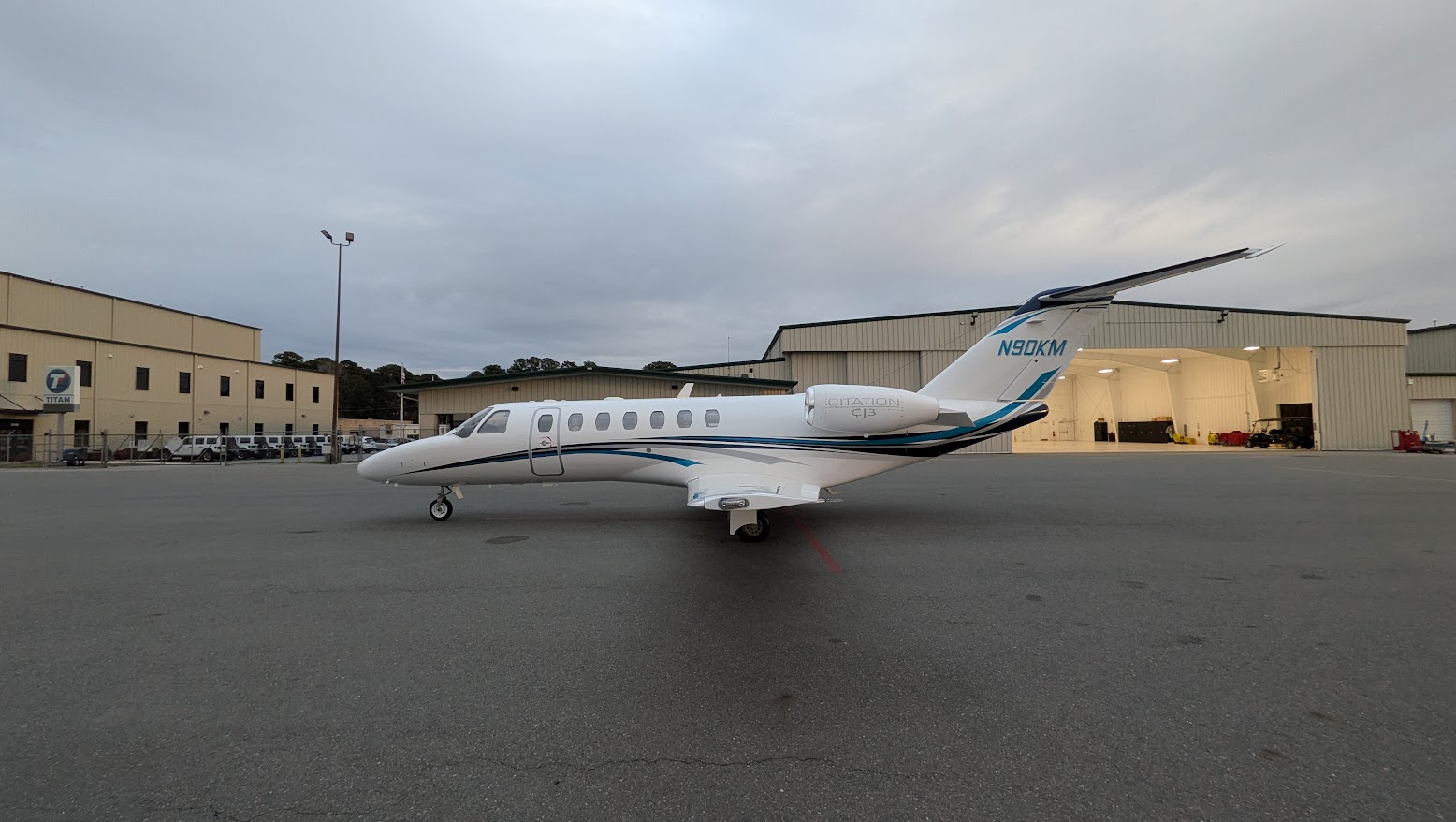
Private jets, also known as business jets or executive jets, represent a fascinating intersection of luxury travel and practical business tools. Whether you’re curious about how they work, who uses them, or what makes them different from the planes you see at major airports, this guide breaks down everything you need to know about these remarkable aircraft.
5,000+
US Airports Accessible
10%
Growth Above Pre-Pandemic
4-19
Typical Passenger Capacity
What is a Private Jet and How Does it Work?
At its core, a private jet is an aircraft powered by jet engines, designed and configured for personal or corporate use rather than mass transportation. These jets operate under different regulations than commercial airlines, specifically under FAA Part 91 for private operations or Part 135 for charter operations in the United States.
The key difference between a private jet and a commercial airliner comes down to purpose and design. Private jets prioritize comfort, speed, and convenience for small groups. They can access over 5,000 airports in the United States alone, compared to the roughly 500 airports served by commercial airlines. This means you can land closer to your final destination, often at smaller regional airports with minimal traffic and faster security procedures.
According to the Federal Aviation Administration’s Business Jet Report, business jet activity serves as a key economic indicator, with analysts tracking these flights to gauge overall business conditions. In September 2023, the United States recorded 12,436 business jet flights, with top airports including Teterboro in New Jersey, Westchester County Airport in New York, and Van Nuys in California.
Key Advantages
- Access to 5,000+ US airports vs. 500 for commercial airlines
- Faster cruising altitudes and more direct routes
- Flexible departure times on your schedule
- Minimal security procedures at private terminals
The Evolution of Private Jets: From 1950s Innovation to Modern Marvel
The history of private jets spans just over 70 years, but the innovation packed into that timeframe is staggering. The first private jet took flight in 1957 when the Lockheed JetStar carried 10 passengers and two crew members into the sky. Modeled after German military fighter jets, this pioneering aircraft could reach speeds of 561 miles per hour, an impressive feat for its time.
However, the private jet market truly ignited in 1963 with the introduction of the Learjet 23. Created by American entrepreneur Bill Lear, this compact jet accommodated just 4 to 6 passengers but revolutionized business aviation with its speed, efficiency, and relatively affordable price point. The same year saw the debut of the Dassault Falcon 20 in Europe, which would go on to become one of the most extensively used jets by FedEx in its early days.
Frank Sinatra became one of the first celebrities to purchase a private jet in 1965, setting a trend that would define luxury travel for decades to come. Elvis Presley followed suit in 1967, purchasing two private jets of his own. These early celebrity adopters helped transform private jets from purely business tools into status symbols.
The industry continued evolving through the 1980s with the introduction of long-range jets like the Gulfstream III, which could traverse intercontinental distances with ease. By 2005, the Dassault Falcon 7X became the first fly-by-wire business jet, replacing manual flight controls with electronic systems. Today’s private jets like the Bombardier Global 7500 boast a 17-hour nonstop flying range, allowing seamless travel from Texas to Tokyo or New York to Hawaii without refueling.
Milestone Achievements
1957
Lockheed JetStar – First private jet
1963
Learjet 23 – Market revolution
1965
Frank Sinatra – Celebrity adoption
2005
Dassault Falcon 7X – Fly-by-wire
Types of Private Jets: Finding the Right Aircraft for Your Needs
Private jets come in seven distinct categories, each designed for specific travel needs and budgets. Understanding these categories helps clarify what makes each type unique.
Very Light Jets (VLJs)
Very Light Jets represent the most compact option in private aviation. The Federal Aviation Administration defines VLJs as aircraft with a maximum takeoff weight under 12,500 pounds. These jets typically accommodate 4 to 6 passengers and offer a range of approximately 1,000 nautical miles or less, making them perfect for short regional trips lasting up to three hours.
VLJs are popular among owner-pilots who hold their own licenses and enjoy flying their aircraft. Their relatively lower acquisition and operating costs make them attractive entry points into private aviation. These jets can access small airfields with short runways and narrow taxiways in remote locations that larger aircraft cannot reach.
Light Jets
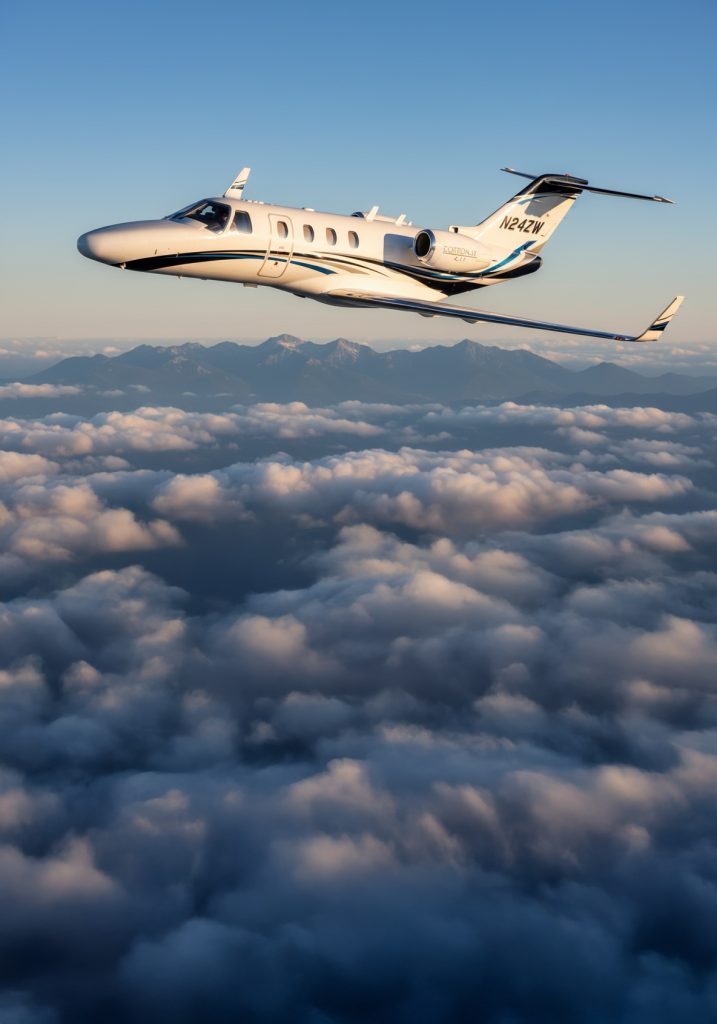
Light jets step up in size and capability, accommodating 6 to 8 passengers comfortably. They offer ranges of 1,500 to 2,000 nautical miles, sufficient for coast-to-coast flights across the United States. Models like the Cessna Citation series, introduced in 1969, helped establish this category as a workhorse for business aviation.
Mid-Size Jets
The sweet spot for many users, accommodating 8 to 10 passengers with ranges exceeding 2,200 nautical miles (approximately five hours of nonstop travel). Features include full standing capacity, onboard lavatories, WiFi connectivity, and in-flight catering capabilities.
Ideal for: Transcontinental flights, executive teams, balanced comfort and cost
Super Mid-Size Jets
Mid-size jets are the sweet spot for many private aviation users. These aircraft accommodate 8 to 10 passengers and boast ranges exceeding 2,200 nautical miles, translating to approximately five hours of nonstop travel. This capability makes them ideal for both short-haul efficiency and transcontinental capacity.
These jets offer full standing capacity for average adults, larger cabins with more headroom, and additional luggage space (around 127 cubic feet). Most mid-size jets include onboard lavatory services, WiFi connectivity, and phone capabilities, allowing passengers to remain productive during flights. They’re operated by two pilots and can accommodate a flight attendant and service galley for in-flight dining.
Large & Heavy Jets
Large jets, also called heavy jets, accommodate 13 to 14 passengers and feature significantly larger cabin sizes that provide first-class comfort. These aircraft can fly nonstop for up to nine hours with ranges approaching 4,000 miles. Popular models include the Bombardier Challenger 605, Gulfstream 450, and Dassault Falcon 900.
Heavy jets typically have room for two flight attendants to manage full in-flight catering, along with space for entertainment facilities, enclosed bathrooms, and dedicated sleeping areas. In-flight productivity is guaranteed with robust WiFi and phone capabilities. One consideration is that these aircraft require longer runways, meaning operations from more congested airports.
Ultra-Long-Range Heavy Jets
For those seeking the pinnacle of private aviation, ultra-long-range heavy jets deliver unmatched capability and luxury. These aircraft feature ranges of 6,000 to 6,500 nautical miles (around 12 hours of flight time), making them ideal for trans-oceanic flights between continents.
Ultra-long-range jets accommodate an average of 14 to 17 passengers in cabins featuring multiple distinct zones for dining, work, entertainment, and relaxation. Complete with enclosed bathrooms, lie-flat beds, full-service galleys, and spacious luggage areas, these jets rose to particular popularity during the COVID-19 pandemic among younger billionaires prioritizing safety and flexibility. Top models include the Gulfstream V, Dassault Falcon 7X, and Bombardier Global 6000.
VIP Airliners (Bizliners)
The largest category of private jets consists of VIP airliners, also known as bizliners. These are wide-body or narrow-body commercial aircraft like the Boeing 747-8 and Airbus ACJ380 that have been converted for private use. They can accommodate anywhere from 19 to 48 passengers in first-class comfort and are commonly used for transporting sports teams, large corporate groups, or government officials.
Private Jets vs Commercial Flights: Understanding the Differences
The contrast between private jet travel and commercial flying goes far beyond just the passenger count. These differences affect everything from your schedule to your safety protocols.
Time Efficiency & Flexibility
Perhaps the most significant advantage of private jets is time savings. While commercial passengers typically arrive 2-3 hours before departure for check-in and security, private jet passengers can arrive just 15-30 minutes before takeoff. There’s no need to remove shoes, separate liquids, or wait in long TSA lines. Security screening happens at private terminals, not the main airport.
Private jets can maintain faster cruising altitudes because they fly above the typical altitude occupied by commercial airliners. Pilots can take more direct routes to destinations instead of following crowded flight paths designed to accommodate hundreds of commercial aircraft. This translates to faster actual flight times, even when the aircraft’s maximum speed is comparable.
Schedule flexibility represents another major advantage. Private jets depart when you’re ready, not according to an airline’s timetable. Need to make multiple meetings in different cities on the same day? Private aviation makes it possible. A 2010 study found that small and midsize companies using private jets produced 219% higher earnings growth compared to those strictly using commercial airlines.
Safety Considerations
Both private and commercial aviation maintain excellent safety records, though they operate under different regulatory frameworks. According to data compiled by aviation safety researchers, Part 121 commercial airlines demonstrated exceptional safety over the 2015-2024 period, with only 3 fatalities recorded across thousands of flights spanning ten years.
Private jets operating under Part 91 regulations have different safety profiles. While Part 91 operations accounted for 93.18% of general aviation fatalities during the same period, it’s important to note this category includes all general aviation (recreational flying, flight training, small aircraft) rather than just business jets specifically.
In 2024, business jet accident fatalities worldwide dropped nearly 35%, from 32 in 2023 to 21 in 2024, demonstrating continued safety improvements in the private aviation sector. The FAA enforces strict safety standards for both commercial and private operations, requiring routine inspections, pilot training, and maintenance checks regardless of aircraft size.
Private jets undergo mandatory annual safety inspections plus additional 100-hour inspections. Top-tier private jet operators voluntarily meet standards set by third-party auditors like ARGUS, IS-BAO (International Standard for Business Aircraft Operations), and Wyvern, which evaluate operator history, safety records, and crew experience beyond basic FAA requirements.
Cost Comparison
Private jets generally cost significantly more than commercial flights, though the gap narrows when you factor in productivity gains and group travel. Charter flights offer access to private aviation without the full expense of ownership, with pricing based on flight hours, aircraft type, and distance traveled.
Commercial airlines spread costs across hundreds of passengers, enabling lower per-ticket prices through economies of scale. However, for groups of executives traveling together, or when time-sensitive business demands justify the premium, private jets can offer reasonable value relative to the benefits received.
Special one-way “empty leg” flights (when jets need to reposition for their next charter) can provide private jet experiences at substantially reduced rates, sometimes approaching business class commercial prices.
The Business Aviation Market: Growth and Statistics
The private jet industry has experienced remarkable growth, particularly in recent years. As of 2025, the global business jet market reached $48.13 billion and is projected to grow to $72.27 billion by 2034, representing a compound annual growth rate (CAGR) of 4.56%.
Currently, there are approximately 22,125 business jets in the worldwide fleet according to industry data. The United States dominates private jet ownership, with Americans owning more than 12,000 private jets (roughly 67% of all private jets worldwide). This translates to the U.S. holding 42-45% of the global business jet market by value.
North America leads with 64.6% of the global fleet, followed by Europe at 13%, South America at 12.1%, and Asia-Pacific at 5.9%. However, the Asia-Pacific region shows the fastest growth trajectory, with an 8% projected CAGR through 2030. India’s private jet fleet alone has grown 25% since 2019, reflecting rising corporate demand and wealth expansion in emerging markets.
According to WingX data, global private jet activity increased year-over-year by 8% during week 13 of 2025, with the United States representing 69.1% of all recorded outbound flights. As Q1 2025 concluded, 900,221 business jet departures were recorded globally, marking a 3% increase compared to Q1 2024.
The top aircraft manufacturers dominating the market include Textron (which owns Beechcraft, Cessna, and Hawker brands) with 43.9% market share, followed by Bombardier at 22.4%, Gulfstream at 13%, Dassault at 9.6%, and Embraer at 5.8%.
Global Fleet Distribution
- North America: 64.6%
- Europe: 13%
- South America: 12.1%
- Asia-Pacific: 5.9%
Top Manufacturers (2025)
- Textron: 43.9%
- Bombardier: 22.4%
- Gulfstream: 13%
- Dassault: 9.6%
2025 Activity Metrics
- 900,221 global business jet departures in Q1 2025 (3% increase YoY)
- 8% year-over-year increase in private jet activity
- 69.1% of outbound flights from United States
- 300% increase in corporate charter requests (2024 vs 2025)

Popular Aircraft Models
Based on September 2023 FAA data, the most preferred aircraft for private business jet travel include:
- Gulfstream Aerospace G550
- Bombardier Global Express
- Dassault Falcon 7X
- Bombardier Challenger 350
- Cessna Citation X
- Bombardier Challenger 300
- Gulfstream Aerospace G650
- Embraer Legacy 600
- Gulfstream Aerospace G450
- Cessna Citation Sovereign
Who Uses Private Jets?
The profile of private jet users has evolved significantly over the decades. While ultra-high-net-worth individuals and celebrities remain prominent users, the majority of private jet travel serves business purposes.
Corporate executives use private jets to maximize productivity, attending multiple meetings across different cities in single days. High-ranking government officials rely on private aircraft for diplomatic missions and secure travel. Medical professionals use private jets for emergency evacuations and organ transport. Entertainment industry figures depend on private aviation to maintain demanding tour schedules.
Notable celebrity pilots who actually fly their own private jets include Tom Cruise, John Travolta, and Harrison Ford. Taylor Swift, Drake, Kim Kardashian, Oprah Winfrey, and Michael Jordan are among the celebrities who own private jets.
Interestingly, private jet passengers have been known to travel with unusual companions. While dogs and cats are common, charter flight crews have welcomed sugar gliders, hedgehogs, snakes, iguanas, miniature pigs, parrots, and even foxes aboard flights.
How to Access Private Jet Travel
You don’t need to be a billionaire to experience private jet travel. Several ownership and access models have emerged to make business aviation more accessible.
Full Ownership
Purchasing a private jet outright provides complete control but comes with significant responsibilities including crew salaries, maintenance, hangar fees, insurance, and regulatory compliance costs. New private jets range from $2 million for very light jets to $500 million for customized VIP airliners.
Fractional Ownership
Fractional ownership programs allow you to purchase a share of an aircraft (typically 1/16th to 1/2 ownership) and receive guaranteed access for a certain number of flight hours annually. You pay only for the portion you own while sharing operational costs proportionally with other owners.
Jet Card Programs
Jet card programs let you pre-purchase flight hours (typically 25-100 hours) on various aircraft types. You pay a set hourly rate with guaranteed availability, predictable pricing, and no long-term commitment beyond your purchased hours.
On-Demand Charter
Chartering allows you to book individual flights without any ownership commitment. You pay only for the flights you take, though pricing can vary based on availability, seasonality, and demand. Charter operators handle all operational aspects, from crew to maintenance to regulatory compliance.
Subscription Services
Newer subscription-based services charge monthly or annual fees for access to a fleet with flexible booking options. Companies like VistaJet have pioneered this model, with over 85% of their customers now being corporations choosing subscriptions over outright ownership. This provides financial flexibility while guaranteeing access to aircraft without managing maintenance, depreciation, or crew.
The Future of Private Aviation
The private jet industry continues evolving rapidly, driven by technological innovation and changing customer expectations. Several key trends are shaping the future of business aviation.
Sustainable Aviation
Environmental concerns have pushed private aviation toward sustainability. Sustainable Aviation Fuel (SAF), made from renewable resources, significantly reduces carbon emissions compared to conventional jet fuel. New aircraft entering service in 2025 arrive SAF-ready, and major operators are implementing carbon offset programs.
Research and development continues on hybrid and electric jet engines with reduced noise and emissions. Manufacturers are exploring lightweight construction materials to increase fuel efficiency. While full electric or hydrogen-powered business jets remain years away from widespread adoption, incremental improvements in fuel efficiency continue advancing.
Technology Integration
Artificial intelligence is transforming flight operations through predictive maintenance, route optimization, and personalized service. AI integration in private jet management is projected to grow at a 15% CAGR through 2028.
Modern private jets feature cabins that function as mobile offices with high-speed WiFi enabling live streaming, advanced entertainment systems, and wellness technologies. Some operators now install LED lighting systems that mimic natural sunlight patterns calibrated to destination time zones, helping reduce jet lag.
Urban Air Mobility
Electric vertical takeoff and landing (eVTOL) aircraft represent an emerging category that could revolutionize short-range private aviation. Companies like Joby Aviation and Vertical Aerospace are developing these aircraft for urban air mobility applications, potentially offering high-speed travel between city centers and airports.
Market Expansion
Geographic expansion continues as the ultra-high-net-worth population grows globally. The Middle East, India, and Southeast Asia show particularly strong growth as liberalized air policies and wealth generation fuel demand. Brazil maintains 764 registered private jets plus an additional 2,000 business aircraft, making it the second-largest market after the United States.
Honeywell forecasts 8,500 new business jet deliveries worth $280 billion by 2035, with North America expected to absorb 66% of shipments. This sustained demand reflects private aviation’s evolution from luxury symbol to business necessity.
Fascinating Facts About Private Jets
Record Range
The Bombardier Global 7500 holds the longest range among private business jets with 17-hour nonstop capability.
In-Flight Innovation
The first in-flight movie screening occurred in 1925 on a private flight from London featuring “The Lost World.”
Presidential Connection
President Lyndon B. Johnson referred to JetStar aircraft as “Air Force One Half” due to their smaller size.
Citation Family
The Cessna Citation family ranks among the most widely used aircraft since 1969.
Status Symbol
Private aviation surpassed luxury yachts and real estate as the top status symbol of modern wealth in 2025.
Market Growth
Australia’s domestic private jet traffic increased 28% since 2020, now accounting for 13% of total bookings.
Experience Private Aviation in Burlington, NC
So, what is a private jet? It’s far more than just a luxury aircraft. It’s a business tool that enables executives to maximize productivity, a safety solution that offers controlled travel environments, and a convenience factor that saves valuable time in our increasingly fast-paced world.
The private aviation industry has transformed dramatically from its 1950s origins when only the ultra-wealthy could access jet travel. Today’s charter services and flexible access models have made private jets available to a broader range of businesses and individuals who value time, privacy, and flexibility.
The market’s continued growth, from $48.13 billion in 2025 to a projected $72.27 billion by 2034, reflects this expanded accessibility combined with sustained demand from business travelers, medical professionals, and anyone who needs efficient point-to-point travel.
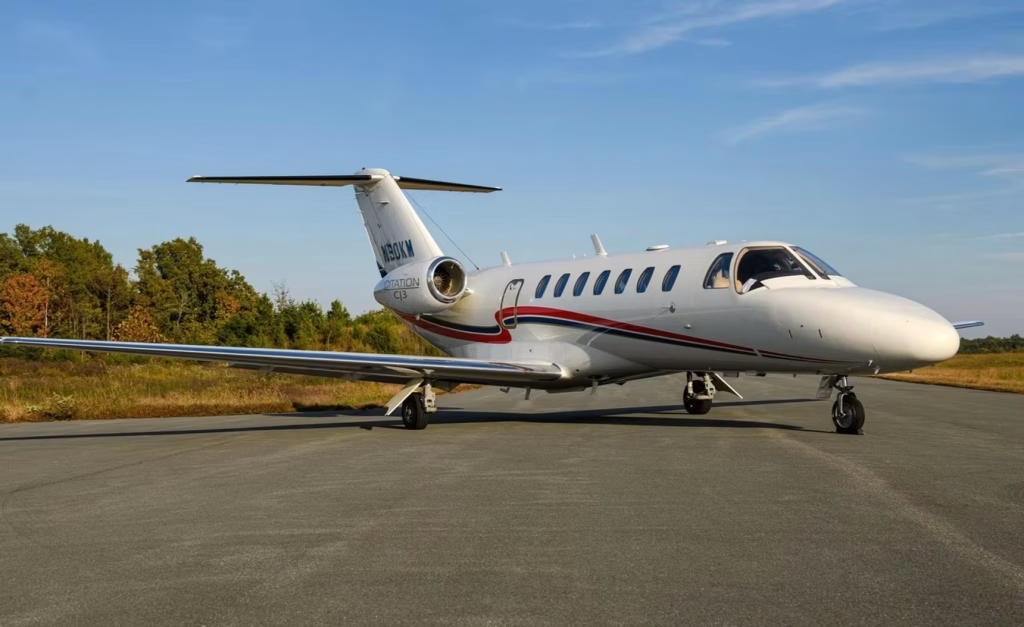
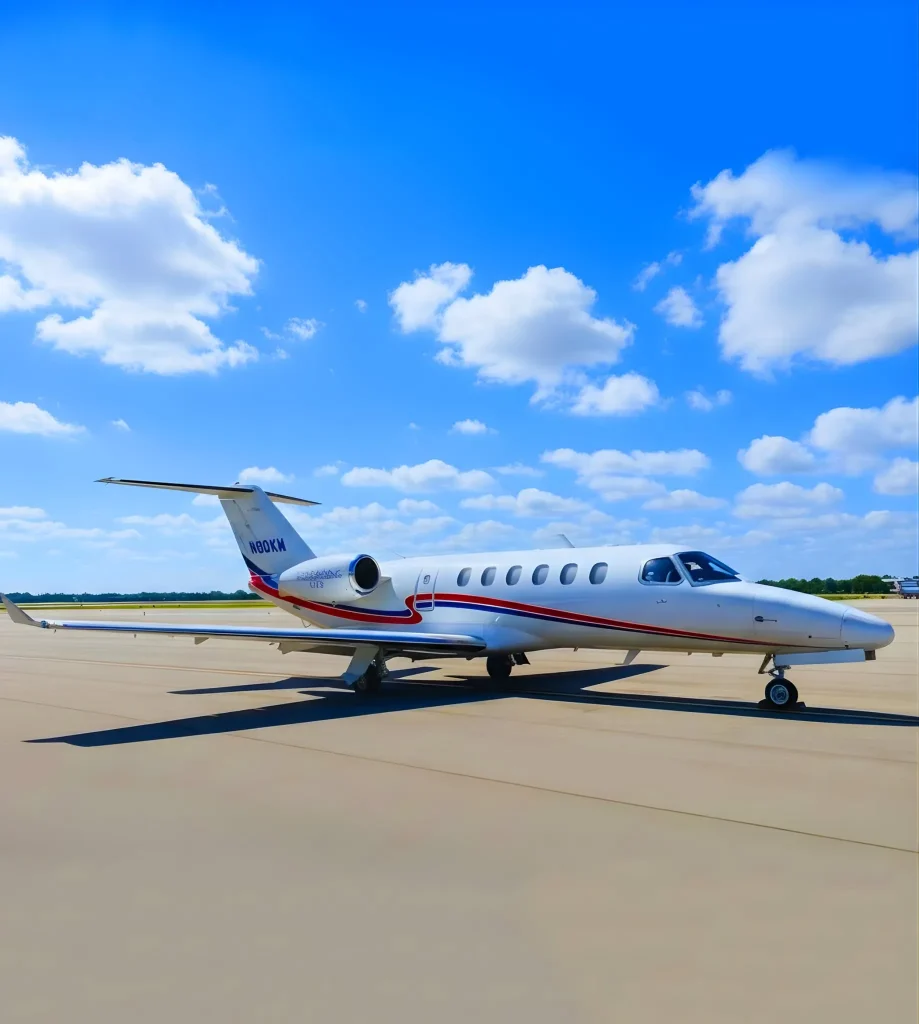
Here in Burlington, North Carolina, SkySouth Aviation operates light jets including the Citation CJ1 and Citation CJ3, two of the most reliable aircraft in business aviation. The CJ1 accommodates 4-5 passengers with a range of 1,200 nautical miles and speeds up to 415 mph, perfect for regional business travel throughout the Eastern United States. The CJ3 steps up with room for 6-7 passengers, a 1,500-nautical-mile range, and speeds reaching 480 mph, making it ideal for longer trips from North Carolina to destinations like Miami, New York, or the Caribbean.
Whether you’re a business executive evaluating travel options between Greensboro, Raleigh, Durham, and Chapel Hill, a medical professional needing reliable organ transport, or an entrepreneur looking to maximize productivity by visiting multiple cities in one day, understanding what private jets offer provides valuable perspective on modern travel efficiency.
Cessna Citation CJ1
- Passengers: 4-5
- Range: 1,200 nm
- Speed: 415 mph
- Use Case: Regional business
Cessna Citation CJ3
- Passengers: 6-7
- Range: 1,500 nm
- Speed: 480 mph
- Use Case: Longer transcontinental
Serving the Triangle Region
Whether you’re a business executive evaluating travel options between Greensboro, Raleigh, Durham, and Chapel Hill, a medical professional needing reliable organ transport, or an entrepreneur looking to maximize productivity by visiting multiple cities in one day, SkySouth Aviation has been providing charter and FBO services since 2003.
We’ve flown thousands of flights to hundreds of airports across the Continental United States, Canada, Bermuda, and the Caribbean. Our Citation jets are maintained to the highest standards and operated by experienced crews who understand that your time matters.
Ready to Fly Private?
The combination of time savings, productivity gains, and travel flexibility that private jets deliver explains why business aviation continues thriving. For me, the most impressive aspect is how private aviation has evolved from an exclusive luxury into a practical solution that professionals across industries can access. The time savings alone often justify the investment when you consider what an extra day of productivity means to your business.
If you’re curious about experiencing private aviation, charter services offer the perfect introduction without ownership commitments. At SkySouth Aviation, we’ve been providing charter and FBO services since 2003, flying thousands of flights to hundreds of airports across the Continental United States, Canada, Bermuda, and the Caribbean. Our Citation jets are maintained to the highest standards and operated by experienced crews who understand that your time matters.
Ready to skip the commercial airline hassles and fly on your schedule? Contact SkySouth Aviation at (336) 639-2151 for 24/7 charter dispatch, or visit our FBO terminal at Burlington-Alamance Regional Airport (KBUY) to learn more about private aviation options that work for your travel needs.
24/7 Charter Dispatch | Burlington-Alamance Regional Airport (KBUY)