Updated February 2026
How Much Does It Cost to Rent a Private Jet
Your Complete 2025 Guide (With Real Pricing from SkySouth Aviation)
How much does it cost to rent a private jet? For most light jet charters operating out of Burlington, NC and across the Eastern United States, you are looking at a starting rate of $2,900 to $3,500 per flight hour, with total trip costs typically ranging from $8,000 to $35,000 depending on distance, aircraft, and the number of passengers.
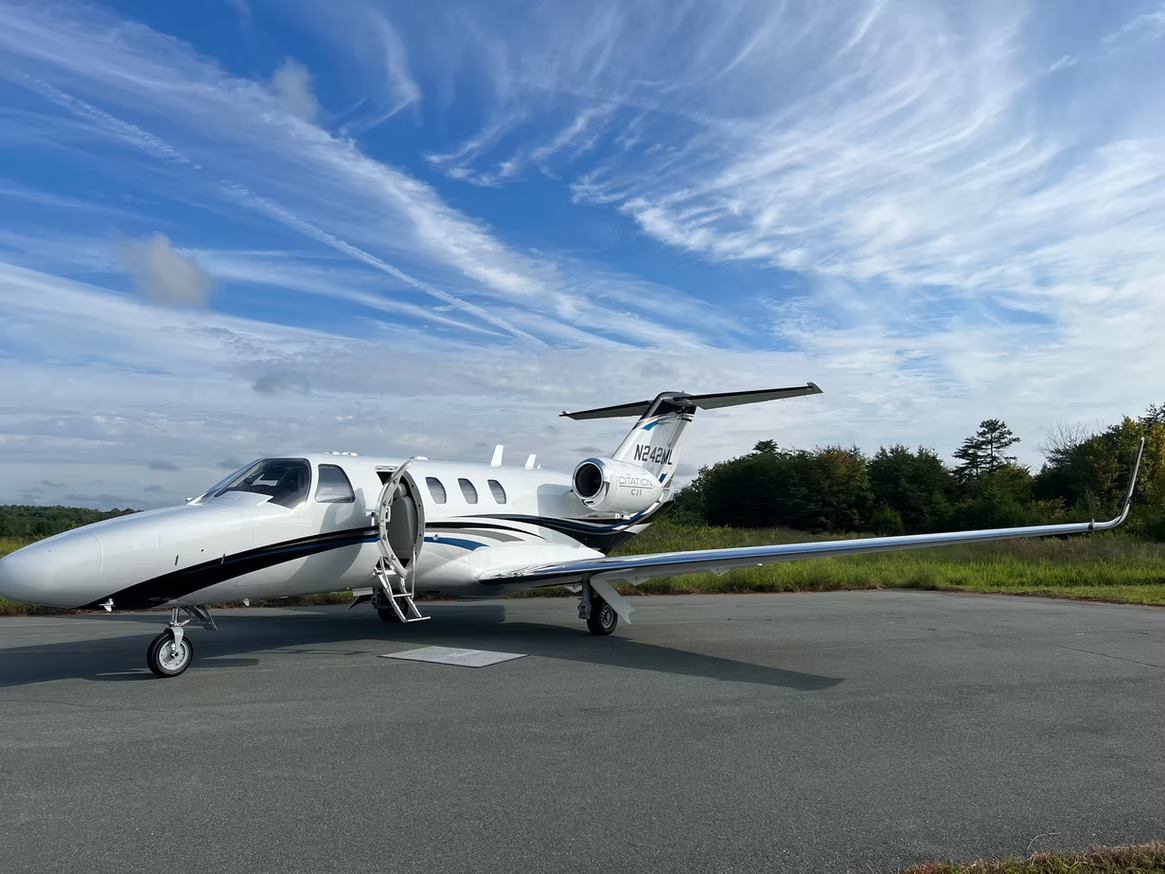
At SkySouth Aviation, we have been operating private jet charters since 2003 out of Burlington-Alamance Regional Airport (KBUY). We fly two aircraft: the Citation CJ1 and the Citation CJ3. Both are light jets built for the Eastern US, and both give you access to airports that commercial airlines simply do not serve.
This guide walks you through exactly how private jet charter pricing works, what fees show up on a real quote, the difference between renting and chartering, and how to figure out whether flying private makes sense for your specific trip. We will keep it honest and specific because that is how you make a good decision.
Use the private jet cost calculator embedded at the end of this article to get an instant estimate for your specific route on either of our aircraft.
1
Use the private jet cost calculator embedded at the end of this article to get an instant estimate for your specific route on either of our aircraft.
Private jet charter is priced by the flight hour, and the hourly rate is set by the aircraft category. Here is how the market breaks down in 2025, from the most economical option to the top of the range
- Turboprop aircraft: $1,500 to $3,000 per hour. Best for short regional trips of under an hour, seats 4 to 8 passengers.
- Light Jets (like the Citation CJ1 and CJ3): $2,500 to $4,500 per hour. The sweet spot for Eastern US travel, day trips, and groups up to 7 passengers.
- Midsize Jets (e.g., Hawker 800XP): $4,500 to $7,500 per hour. More cabin room, up to 5-hour range, good for cross-country.
- Super Midsize Jets: $6,000 to $9,500 per hour. Longer range and more interior space.
- Heavy Jets (e.g., Gulfstream G450): $12,000 to $22,000 per hour. Built for international travel and large groups.
- Ultra-Long-Range Jets (e.g., Gulfstream G650): $16,000 to $24,000+ per hour. Intercontinental range, the most luxurious category.
For the routes SkySouth flies most, the Eastern US, Caribbean, and select Canadian destinations, a light jet is the right aircraft for the job. You do not pay for range and cabin space you are not using, and our Citation jets can access regional airports with runways as short as 3,250 feet, putting you closer to where you are actually going.
By the Numbers: The private jet charter services market was valued at $16.38 billion in 2025, projected to reach $25.79 billion by 2031. North America accounts for over 81% of global revenue, driven by the largest concentration of high-net-worth individuals and the most developed private aviation infrastructure in the world.
2
SkySouth Aviation: Our Aircraft and Pricing
Here is what it actually costs to fly with SkySouth. These are our published starting rates, and what goes into the final number on your quote.
Citation CJ1: From $2,900 Per Flight Hour
The CJ1 is the most cost-effective entry into private jet travel. It carries 4 to 5 passengers, cruises at 390 mph, has a range of 1,200 nautical miles, and a maximum altitude of 41,000 feet, putting you comfortably above commercial traffic and most weather systems. The minimum runway requirement of 3,250 feet opens up dozens of regional airports across the Carolinas, Virginia, Tennessee, and beyond.
It is the ideal aircraft for short to mid-range business trips, family travel, and quick turns where you need to be there and back the same day. The cabin features premium leather executive seating, stowable work tables, a refreshment center, power outlets, and a compact lavatory.
Citation CJ3: From $3,500 Per Flight Hour
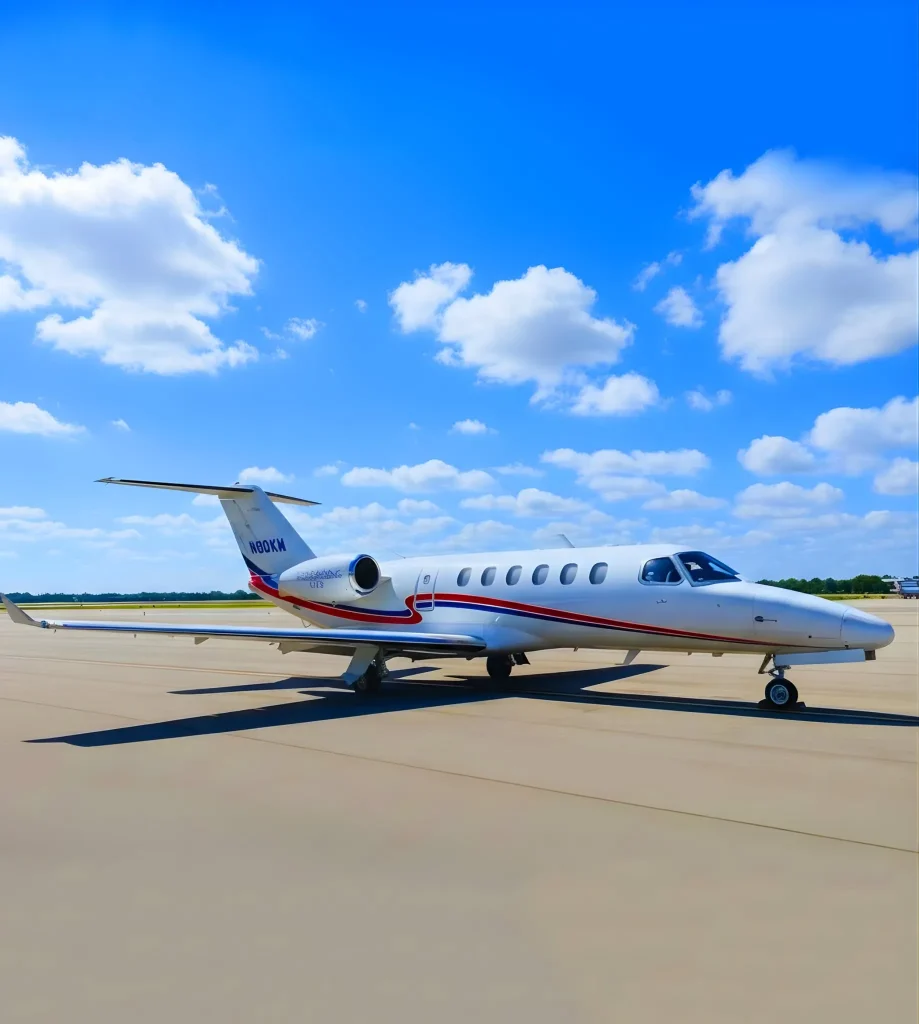
The CJ3 is the most popular light jet in the charter industry, and for good reason. It carries 6 to 7 passengers, cruises at 405 mph, extends range to 1,500 nautical miles, and reaches a ceiling of 45,000 feet. The January 2026 interior refresh gave it new leather seating, updated cabin finishes, and modern amenities throughout.
If you are moving a full team, bringing the whole family, or heading somewhere with more distance involved like the Bahamas, Turks and Caicos, or New York, the CJ3 is the better choice. The extra cabin space and range make a real difference on longer legs.
Both jets are based at Burlington-Alamance Regional Airport (KBUY), which puts Greensboro, Chapel Hill, Durham, Raleigh, and Elon University all within easy driving distance of your departure gate. You park next to the jet, load your bags, and you are wheels up on your schedule.
3
What Does a Complete Private Jet Quote Actually Include?
The hourly rate is the starting point, not the total. Here is a full breakdown of every cost component that shows up on a real charter quote.
1. Billable Flight Time
Billable flight time runs from wheels up to wheels down and includes any positioning time if the aircraft needs to reposition to your departure airport. Light jets carry a 2-hour daily minimum charge, so a very short trip still bills a minimum of 2 hours per day of travel.
2. Fuel Surcharges
Many operators, including SkySouth, include fuel in the hourly rate. Some quote it as a separate line item. If you see a fuel surcharge on a quote, it typically runs $300 to $400 per billable hour for light jets. Always confirm whether fuel is bundled before comparing quotes.
3. Landing and Handling Fees
Landing fees are charged by the airport authority and range from $150 to $1,500 per arrival depending on airport size and aircraft weight. Ramp and handling fees from the Fixed-Base Operator (FBO) add another $100 to $500 per visit. At smaller regional airports like KBUY, these fees are significantly lower than at major commercial hubs.
4. Federal Excise Tax (7.5%)
All domestic charter flights within the United States carry a 7.5% Federal Excise Tax on the transportation charges. Per the National Business Aviation Association (NBAA), this applies to any charter beginning and ending within the US or its 225-mile border zone. A domestic segment fee of $5.30 per passenger per leg also applies as of 2026 under IRS Form 720.
5. Crew Expenses
Overnight trips add per diem and lodging for the flight crew, typically $200 to $600 per crew member per night. A two-person crew staying overnight adds roughly $750 to $1,500 to your total. Same-day round trips avoid this cost entirely.
6. Catering and In-Flight Services
Base charter pricing does not include catering. Custom in-flight meals and beverages range from $230 to $2,000 per leg depending on your requests. Ground transportation and concierge services are also available as add-ons.
Pro tip: A same-day round trip eliminates overnight crew costs and can significantly reduce your total bill compared to a trip with an overnight stay.
2
Sample Route Pricing from Burlington, NC
- Here are realistic all-in cost estimates for popular SkySouth routes, based on our published rates plus standard fees and federal taxes. These are estimates; contact us for a firm quote.
• Burlington, NC to New York City (approx. 600 miles): Citation CJ3, round trip same day, estimated $18,000 to $22,000 total
• Burlington, NC to Miami, FL (approx. 900 miles): Citation CJ3, round trip same day, estimated $24,000 to $30,000 total
• Burlington, NC to Nashville, TN (approx. 500 miles): Citation CJ1, round trip same day, estimated $14,000 to $18,000 total
• Burlington, NC to The Bahamas (approx. 950 miles): Citation CJ3, round trip with overnight, estimated $28,000 to $36,000 total
• Burlington, NC to Chicago, IL (approx. 750 miles): Citation CJ3, round trip same day, estimated $22,000 to $26,000 total
• Burlington, NC to Turks and Caicos (approx. 1,100 miles, within CJ3 range): estimated $34,000 to $42,000 round trip with overnight
Remember: these figures are for the entire aircraft. Split a $22,000 New York trip across 6 passengers and each person pays roughly $3,667. That is competitive with first-class commercial fares on the same route, and you leave when you want, land where you want, and skip every commercial terminal entirely.
4
Renting vs. Chartering a Private Jet: What Is the Difference?
This question comes up constantly, and the terminology gets used interchangeably depending on who you are talking to. Here is the actual breakdown.
What Is a Charter Flight?
A charter flight means you are booking the entire aircraft through a licensed operator for a specific trip. The operator, like SkySouth, handles crew, fuel, maintenance, and logistics. You show up, fly, and leave. No long-term commitment, no ownership responsibilities, no contract beyond the trip itself.
All legitimate charter companies in the United States operate under FAA Part 135 certification, the regulatory framework for non-scheduled commercial air service. Part 135 sets standards for pilot qualifications, maintenance schedules, operational procedures, and crew rest requirements, and it is governed by the full regulatory text found in 14 CFR Part 135 on the eCFR.
What Is Renting a Private Jet?
In everyday language, renting and chartering a private jet mean the same thing to most travelers. When you search “how much does it cost to rent a private jet,” you are almost certainly asking about the on-demand charter model above.
In the technical aviation world, leasing is a separate concept: you rent an aircraft for a defined period (weeks, months, or years) rather than a single trip. A dry lease gives you the aircraft without crew or maintenance; a wet lease bundles everything together. These structures are used primarily by companies with their own flight departments. For individual travelers and most businesses, on-demand charter is the right model.
5
Part 135 vs. Part 91: Why It Matters to You
Part 91 governs private non-commercial flights. If someone owns a plane and flies family and friends with no compensation changing hands, they operate under Part 91, with less stringent rules.
Part 135 governs charter, the commercial side. Stricter pilot training, mandatory safety audits, flight-following technology, and more rigorous maintenance programs are all required. An independent analysis found that between 2010 and 2020, Part 91 operations accounted for 31 fatal accidents, while commercial Part 135 turbine jet charters recorded just three in the same period. The regulatory framework produces meaningfully safer operations.
When you fly with SkySouth, you fly under Part 135. Our pilots bring thousands of flight hours, and our safety record reflects over two decades of reliable operations.
Why Light Jets Are the Smart Choice for Eastern US Travel
- Heavy jets and ultra-long-range aircraft get most of the attention in private aviation conversations, but for the routes most SkySouth clients actually fly, a light jet is the objectively better choice. Here is why.
- • You are not paying for range you do not need. A Gulfstream G650 costs $16,000 to $24,000 per hour. The CJ3 at $3,500/hr gets you to Miami, New York, Nashville, Chicago, and the Caribbean. Why pay for intercontinental range on a 600-mile trip?
• Light jets access more airports. Both the CJ1 and CJ3 require only 3,250 feet of runway, which opens up regional and executive airports that heavy jets cannot use. This often means landing closer to your actual destination and avoiding the congestion of major commercial hubs.
• Faster turnaround. Smaller aircraft means faster fueling, faster loading, and less ground time. You arrive, you go.
• Better economics for groups of 4 to 7. Light jets are sized precisely for the groups most people actually travel with. You are not paying to heat, fuel, and staff a 14-seat cabin for four passengers.
6
How to Access a Private Jet: Charter, Jet Cards, and Fractional Ownership
There are several ways to fly private, and each suits a different travel pattern.
On-Demand Charter (What SkySouth Offers)
Book the aircraft you need for a specific trip. Pay for it. Done. This is the right model for travelers who fly privately fewer than 50 hours per year. You get full flexibility to choose the aircraft that fits each trip, no upfront commitment, and access to the global charter fleet if your trip needs something outside our fleet.
For first-time charter clients, this is always the right starting point. Call our 24/7 dispatch at (336) 639-2151, describe your trip, and we quote you a flat all-in price.
🛡️
Jet Cards
A jet card lets you pre-purchase a block of flight hours at a fixed rate, locking in your pricing before you fly. This works well for travelers flying 25 to 100 hours per year who want pricing predictability and guaranteed availability. Market data projects jet card programs will grow at a 9.63% CAGR through 2031 as travelers prioritize fixed costs.
✓
Fractional Ownership
Fractional ownership means buying a share of an aircraft, entitling you to a defined number of annual flight hours. Companies like NetJets and Flexjet lead this segment. It makes financial sense for those flying 100 to 400 hours annually. Below that threshold, on-demand charter almost always costs less when you factor in all the fixed costs of ownership.
🌍
Full Ownership
Buying a private jet means $3 million to $90 million in acquisition cost, plus $700,000 to $4 million in annual operating expenses covering maintenance, crew, hangar fees, insurance, and fuel. Aviation experts consistently recommend ownership only for those flying 300 or more hours per year. For everyone else, charter delivers the same experience without the overhead.
Empty Leg Flights
Empty leg flights occur when an aircraft needs to reposition to its home base or next pickup without passengers. Rather than fly empty, operators list these at discounts of 50% or more. They require schedule flexibility since the route and timing are fixed, but for travelers who can work around that, they are an exceptional value. Ask us about empty leg availability when you call.
7
The Government Framework: FAA Part 135, Safety Standards, and Taxes
The regulatory side of private aviation is worth understanding because it directly affects the safety and cost of your flight.
FAA Certification
Every charter company operating in the United States must hold an FAA Air Carrier Certificate under Part 135. The full operating requirements are codified in 14 CFR Part 135. When you book with any charter operator, ask to see their Air Carrier Certificate. Any legitimate operator will provide it without hesitation.
Third-Party Safety Audits
Beyond FAA minimums, the industry benchmark for safety is certification by ARGUS (Platinum is the highest tier) and Wyvern Wingman. These independent programs audit operator safety culture, pilot records, maintenance programs, and operational procedures. Reputable charter operators and brokers require their partners to hold these ratings.
Federal Excise Tax
As noted, all domestic charter flights carry a 7.5% Federal Excise Tax on transportation charges per IRS rules. Per the NBAA Federal Excise Tax Guide, this applies to flights beginning and ending in the United States. A segment fee of $5.30 per passenger per leg also applies in 2026. These taxes are included in every SkySouth quote so there are no surprises.
Passenger ID Requirements
Under Part 135, passengers 18 and over are required to present a government-issued photo ID, the same requirement as commercial airlines. This applies to all SkySouth charter flights.
8
Private Aviation by the Numbers: Market Statistics
Private aviation is a larger and faster-growing industry than most people realize. Here are the figures that put the market in context:
• Approximately 22,000 private jets are in operation worldwide as of 2024.
• The private jet charter market was valued at $21.24 billion in 2024, projected to reach $24.28 billion in 2025.
• North America holds roughly 44.83% of global private jet charter market share, the largest of any region.
• Demand for private aviation grew 32.1% above pre-pandemic 2019 levels, with much of the growth coming from first-time charter clients.
• The global business jet market is projected to grow from $72.15 billion in 2024 to $113.48 billion by 2030, per Grand View Research.
• The accident rate for private jet charter operations under Part 135 is among the lowest in general aviation.
• Light jets represent more than 36% of all private jets owned globally, making them the most common category in the market.
9
Private Jet Charter vs. First-Class Commercial: An Honest Comparison
The question almost every first-time charter client asks is whether private is worth it compared to first-class commercial. Here is the honest answer.
• Cost: First-class commercial is cheaper for solo travelers on major routes. A business-class seat New York to Miami might run $800 to $1,500. A private CJ3 charter on the same route runs $24,000 to $30,000 total. For six passengers splitting that cost, it becomes $4,000 to $5,000 per person, which competes directly with premium commercial pricing, especially on routes with poor direct service.
• Time: Private aviation wins clearly. Arrive 10 to 15 minutes before departure, skip security lines entirely, and land at a regional airport closer to your destination. A trip that takes 6 hours door-to-door commercially might take 3 hours privately.
• Flexibility: No contest. You depart on your schedule, change plans if needed, and choose your airports.
• Privacy: A chartered jet is yours entirely. No fellow passengers, no overheard conversations, no risk in a sensitive business setting.
• Comfort: Both premium commercial and private offer excellent seating. The difference is that a private cabin is designed for 4 to 7 people, not 200.
• Access: Commercial airlines serve roughly 500 airports in the US. Private jets access more than 5,000, including the regional airports that actually put you near your destination.
For a solo traveler on a well-connected route with schedule flexibility, first class makes financial sense. For a team, a family, or anyone whose time carries a dollar value, run the numbers on private charter. You may be surprised how close they get.
10
Ways to Save on Private Jet Charter
Private aviation does not have to mean the highest possible ticket. Here are legitimate ways to reduce your cost:
- Book a same-day round trip. This eliminates overnight crew costs and reduces total billable time compared to an overnight stay.
- Fly out of Burlington (KBUY) or a regional airport. Lower landing fees and handling charges compared to major hubs, and a faster boarding experience.
- Ask about empty legs. If we are positioning an aircraft near your route, you may be able to take advantage of a significantly reduced rate.
- Travel in a full group. The per-person cost of a CJ3 at 7 passengers is dramatically lower than the same aircraft with 2 passengers.
- Choose the right aircraft for the trip. If you have 4 passengers and are flying 400 miles, the CJ1 at $2,900/hr is the economical choice. The CJ3 is worth the upgrade when you need the extra seats or range.
- • Get quotes in advance. Last-minute bookings can sometimes carry higher rates depending on availability.
Frequently Asked Questions
Our 24/7 dispatch line at (336) 639-2151 can typically execute a domestic booking within 3 to 6 hours. International trips with permit requirements need more lead time, often 24 to 72 hours. We prefer advance notice but last-minute domestic charters are entirely possible when aircraft are available.
SkySouth is based at Burlington-Alamance Regional Airport (KBUY) in Burlington, NC. From there, we serve the Continental US, Canada, Bermuda, and the Caribbean. Popular departing areas include Greensboro, Raleigh, Durham, Chapel Hill, and Elon University, all within easy driving distance of KBUY. We can also position aircraft to a departure airport that is more convenient for your group.
Yes. One-way charters are common. Depending on the route, a positioning fee may apply if the aircraft needs to reposition to reach you. One-way trips are also where empty leg pricing becomes most relevant.
Our all-in quotes include the aircraft, crew, fuel, landing fees, and applicable federal taxes. We break down every line item so you see exactly what you are paying for. There are no hidden fees in the final invoice.
The Citation CJ1 seats 4 to 5 passengers. The Citation CJ3 seats 6 to 7 passengers. Both are configured in a club-style layout with face-to-face seating, stowable tables, and refreshment centers. Baggage capacity on both is 57 cubic feet.
Yes. SkySouth provides medical transport services and is trusted by doctors and hospitals across the country for critical organ and patient transport. Our pilots are experienced with time-sensitive medical missions. Contact our dispatch directly to discuss medical transport requirements.
Part 135 commercial charter operations, operated by FAA-certified carriers with third-party safety audits, represent the highest safety standard in general aviation. An independent analysis of a 10-year period found just three fatal accidents in Part 135 turbine business jet charter operations involving US-registered aircraft. SkySouth has operated since 2003 with a proven safety record built across thousands of flights.
My Recommendation: How to Start Flying Private
After over two decades operating in this market, here is the honest advice I give to anyone considering flying private for the first time.
If you are flying privately for the first time or flying fewer than 25 hours per year, start with a single on-demand charter. Do not buy a jet card, do not commit to fractional ownership, and definitely do not buy an aircraft. Call SkySouth at (336) 639-2151, describe your trip, and get a real all-in quote. No obligation, no hidden steps.
Try the CJ1 if you are 4 passengers or fewer on a shorter route. Try the CJ3 if you want more room, have a larger group, or are heading somewhere with more distance. Both aircraft will change how you think about travel.
If you fly 25 to 100 hours a year and want pricing predictability, a jet card is worth considering. If you are consistently above 100 hours, the fractional ownership conversation starts to make financial sense. But for most people, on-demand charter is the right model: you pay only when you fly, you always get the right aircraft for the trip, and you stay completely flexible.
The bottom line is that private aviation is more accessible than most people assume. The per-person math on a full CJ3 is often closer to a first-class commercial seat than you would expect, without the airports, the wait, or the crowd. If a specific route has ever made you think it might be worth it, it probably is. Let us run the numbers with you.
Regulatory and Government Resources Referenced
About SkySouth Aviation: SkySouth is a FAA Part 135 certified private jet charter operator and FBO based at Burlington-Alamance Regional Airport (KBUY) in Burlington, NC. Founded in 2003 by Kevin Mock, SkySouth operates the Citation CJ1 and Citation CJ3 and serves the Continental US, Canada, Bermuda, and the Caribbean. 24/7 Charter Dispatch: (336) 639-2151. FBO Front Desk: (336) 226-3330. Address: 3441 North Aviation Dr, Burlington, NC 27215.